Monstress, Volume 6: The Vow by Marjorie Liu & Sana Takeda – Graphic Novel Review

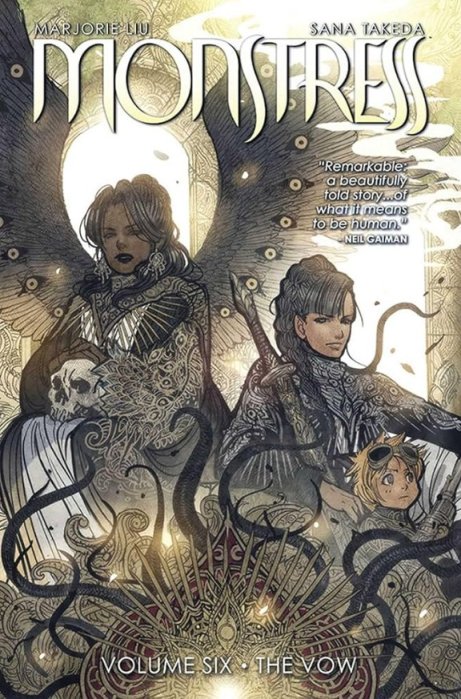
Monstress, Volume 6: The Vow by Marjorie Liu & Sana Takeda - Graphic Novel Cover

Marjorie Liu and Sana Takeda’s graphic novel series is a mind-blowing creation that takes place in a fantasy world like no other. A world that’s unbelievably complex, brutally unforgiving, and heartbreakingly beautiful all at once. Monstress: The Vow, the sixth volume in the series, continues the saga full of power struggles, hidden supernatural beings, betrayals, and horrors—where Maika Halfwolf, the protagonist, not only faces countless enemies, but can’t even trust her friends—or her own family. The only one she might be able to count on is the ancient, bloodthirsty entity lurking inside her.

Monstress Takes the Graphic Novel to a Whole New Level

The creators of Monstress, the Lennon and McCartney of the graphic novel world—Marjorie Liu and Sana Takeda—have basically swept every major sci-fi and fantasy award with their joint masterpiece. And if they haven’t yet, they definitely will. Deservedly so.

The war between humans and Arcanics is being manipulated by otherworldly forces. Supernatural beings walk the earth, sometimes in their true forms, other times hiding behind masks—or in someone else’s skin—fighting each other for power. In this chaotic, utterly opaque, and constantly shifting web of alliances, Maika Halfwolf and her few remaining friends are just trying to stay alive.

All of this is delivered in panels that look like paintings.

Read more

The Night Agent by Matthew Quirk – Book Review

The Night Agent by Matthew Quirk – Book Cover

At the White House, a secret phone line can ring at any moment. FBI agent Peter Sutherland, sidelined to the fringes, has spent the past year working the night shift, waiting for a call that may never come. His only task: to answer and pass it along to the right people. When the phone finally rings, and a young woman in mortal danger begs for help, Peter follows his conscience. And just like that, he finds himself caught in a life-threatening conspiracy.

The Night Agent is Impossible to Put Down

It’s rare to come across a book that pulls you in with such ferocity as Matthew Quirk’s spy thriller—at least for the first 80 pages. Quirk sets the stage with an immediate sense of tension, relentless action, and a merciless antagonist, making the pages fly by.

Action, life-or-death stakes, a covert power play inside the White House. Spies operating under the radar. And to top it all off, the Russian GRU makes an appearance—an agency that, compared to them, even the FSB (the successor of the old KGB) seems like a bunch of Girl Scouts. At least, according to Matthew Quirk. And once the GRU shows up, they waste no time hunting down anyone who gets too close to the fire.

That’s about the first 80-100 pages of The Night Agent. If you don’t want to be disappointed, stop reading right there! And that applies to both the book and this review.

Read more

The Fort by Adrian Goldsworthy – Book Review

The Fort by Adrian Goldsworthy – Book Cover

During Emperor Trajan’s reign, Rome fought multiple wars against the Dacians, who inhabited what is now Romania. The tribes united under Decebalus posed a constant threat to the empire—just as the Romans did to them. Flavius Ferox, centurion and protagonist of Adrian Goldsworthy’s City of Victory trilogy, takes command of the frontier fort of Piroboridava. If the Dacian armies, preparing for war, decide to march, this fort will be the last line of defense before the provinces.

Through the Eyes of a Historian

Following his Vindolanda novels, Adrian Goldsworthy continues the adventures of his British-born Roman officer, who now finds himself on the empire’s opposite frontier, accompanied by his warrior-queen wife, Claudia Enica. Despite being far from the City and focusing on the relatively low-ranking officers of a minor fort, Goldsworthy still manages to paint a complex picture of how the Roman Empire operated—particularly from a military perspective.

As Flavius Ferox strengthens the fort’s defenses against the looming war, all while dealing with the resentment of the tribal warriors under his command and the rightful anger of his warrior-spirited wife—historian Goldsworthy, too, demonstrates his expertise.

However, if you’ve already prepped for Roman history by devouring classics—say, Colleen McCullough’s brilliant Masters of Rome series—and consider yourself something of an expert, you might still find the sheer volume of Latin terminology overwhelming, from military ranks to soldier slang.

Read more

Dune: Part Two (2024) – Film Review

Dune: Part Two (2024) – Film poster

Denis Villeneuve took on a monumental challenge in 2023: adapting a sci-fi classic that had defeated every filmmaker before him. Yet, against all odds, Villeneuve pulled it off surprisingly well. He brought Frank Herbert’s colossal saga to the big screen with minimal alterations—at least in terms of its essence—faithfully adapting the first book (or, to be precise, roughly its first half). But when it comes to Dune: Part Two, things aren’t quite as straightforward.

Dune: Part Two is a GOOD movie, if…

…you haven’t read the book.

If that’s the case, you’re in for a spectacular, at times overwhelming revenge story. After being exiled and losing his father due to the schemes of the Emperor and the villainous Baron Harkonnen, Prince Paul Atreides finds himself in the best possible place to exact his revenge: the most hellish place in the universe, the desert planet Arrakis—also known as Dune.

This barren wasteland is home to the Empire’s most valuable resource: the spice, a substance that extends life and expands human consciousness. The planet’s oppressed native tribes, the Fremen, have long been impatiently awaiting their prophesied messiah. Meanwhile, the mysterious Bene Gesserit order, which has spent millennia manipulating noble bloodlines in hopes of bringing forth the human supercomputer known as the Kwisatz Haderach, has already laid the groundwork centuries in advance.

Read more

Sword of Destiny by Andrzej Sapkowski – Book Review

Sword of Destiny by Andrzej Sapkowski – Book Cover

Monster Slaying in a Not-So-Original World

The best thing about the second installment of Sapkowski’s Witcher series is that you can decide whether you want to continue reading right after the first two short stories. This is because the very first story in Sword of Destiny is, to put it bluntly, the weakest one, almost like an unintentional parody of itself. The second story, on the other hand, is the best, tying for first place with the last one.

Andrzej Sapkowski’s method remains the same as in the first book (see The Last Wish). The Witcher roams a rather unoriginal fantasy world, encounters various monsters and mythical creatures, while a cheering crowd behind him urges him to chop them up as quickly as possible. And the Witcher? Well, sometimes he chops them up, and sometimes he doesn’t.

Wait, Is This a Children’s Story?!

Unfortunately, the fairy-tale stereotypes once again drag Sapkowski’s book down. In the stories of Sword of Destiny, dragons hoard treasures in their caves. Okay, that was fine in The Lord of the Rings, but a few decades have passed since then. Even if we accept the premise that a dragon, this mindless beast, would first rob a few wealthy citizens before devouring them, then pack the stolen jewels into a purse with its paws—excuse me, claws—and haul them back to its cave, then sort them by carat value with a magnifying glass perched on its snout… it’s still a bit much to swallow that this monster can speak. And eloquently as fuck, at that…

Read more

The King’s Gambit by John Maddox Roberts – Book Review

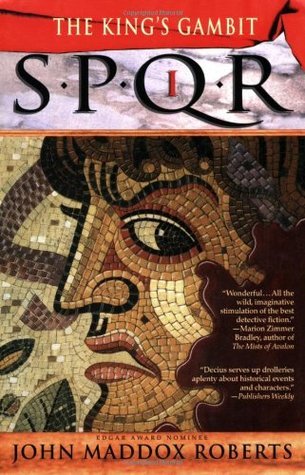
The King's Gambit by John Maddox Roberts – Book cover

In the opening volume of what is now a historical crime series spanning more than ten books, Decius, a low-ranking official at the very bottom of the Roman hierarchy, begins investigating the murder of a freed slave. The time: 70 BC, smack in the middle of the Roman Republic’s period of crisis. And guess who Decius runs into right in the very first chapter of The King’s Gambit? Bingo, you got it: the equally green and freshly ambitious Gaius Julius Caesar. Later on, of course, more famous faces from the era show up—everyone from Pompey the Great and Cicero to the scoundrel Publius Clodius Pulcher.

More of a Historical Novel than a Whodunit

Now, technically speaking, The King’s Gambit is a crime novel—it checks off a bunch of the genre’s usual boxes (forensic expert, informant, tough-guy sidekick)—but you still kind of feel like you’re reading historical fiction. The investigation itself is pretty thin, not particularly thrilling or original (there are moments when John Maddox Roberts rather clumsily uses well-known historical facts just to nudge the plot forward—hello, pirates), and most of the time it gets drowned out by long digressions into the political and historical dynamics of the day. Not least because young Decius becomes OBSESSED with the idea that he’s stumbled right into the middle of an anti-state conspiracy. And that everyone is out to get him. Um… what?!

A Conspiracy? Oh, Please.

That grand conspiracy claim eventually fizzles out and turns into nothing more than a plain old political scheme. Typical. But Decius doesn’t let go—he keeps digging into the case. No one understands why he’s MAKING SUCH A FUSS over a murdered slave. No one. Not even you.

The first book in John Maddox Roberts’s SPQR series honestly feels more like the pilot episode of a detective TV show. It’s a bit clunky, a little unsteady, but maybe not terrible—and you can’t help but hope the series eventually finds its stride.

It Feels Like You’re Actually in Rome

What definitely works in The King’s Gambit’s favor, though, is its setting, which feels completely authentic. For instance, I gave up on the similarly themed Gordianus series precisely because it lacked that feeling. It didn’t help that I had just finished reading Colleen McCullough’s epic Masters of Rome series, which made Gordianus fall flat by comparison.

Luckily, The King’s Gambit doesn’t suffer the same fate. In fact, quite the opposite. Almost every other paragraph drops in some piece of information so naturally woven into the text that it helps you better understand the political and civic backdrop of the time—or just makes you feel like you’re right there, tagging along with eager-beaver Decius through the cramped, stone-paved alleyways of ancient Rome.

Rating: 6.9/10

The King’s Gambit (SPQR #1) by John Maddox Roberts
274 pages, Paperback
Published in 1990 by Minotaur Books

You might also like:
The Fort by Adrian Goldsworthy