The Other Son by Alexander Söderberg – Book Review

The Other Son by Alexander Söderberg – Book Cover

Sophie Brinkmann enters a criminal organization as an outsider (see: The Andalucian Friend). This profession is better learned from the ground up because if you just dive into it like Pilate into the Creed, you might end up making a professional mistake. Which could result in getting shot a few times.

So, an Other Son? Moreover, a stepchild?? He’s missing from her life like a hump on her back!

But let’s hear the good news instead: Alexander Söderberg’s second installment in the series is much more action-packed than the first. First off, it lacks that somewhat dull exposition. Then, what’s good about it is that the story is entirely unpredictable; you never know which direction the plot will take. And listen, in The Other Son, you might even find yourself genuinely rooting for a character. Or more than one.

The recipe for the second volume is familiar from the previous installment: two separate groups, two separate stories, the adventures of Sophie and Hector, who is just emerging from a karmacoma (see Karmacoma on YouTube), and the police investigation, which only converge at the end of the book. And speaking of police investigation: unfortunately, the same disappointing storytelling element enters here as in the first volume: the dirty cop effect; only while it was somewhat believable there, here, it starts to approach incredibility, as the slowly going completely crazy Big Chief Tommy would be much better off laying low, because this way nobody would tie him to the crimes of the previous part.

And how did this happen?

Well, there was a need for a villain, and there you go. Of course, it could also be explained by Alexander Söderberg’s love for creating messed-up characters, especially those in law enforcement (just remember the drug-addicted sociopath and his colleagues from the prequel). In Miles’ case, you can’t quite decide what the heck he’s doing in the story; his self-discovery and romance are entirely unnecessary from the perspective of the big picture, but nevertheless, these are perhaps the most noteworthy parts of the book. And the joint investigation with his colleague didn’t turn out bad either, even though you’d initially think it would fizzle out completely because they sniff around what was the main plot of the previous volume. So, you know what they’re going to figure out, but it’s still exciting to see how they keep moving forward despite all the obstacles.

However, Sophie, the well-meaning family woman sinking into the swamp of crime, has to experience the lesson behind the proverb “If you lie down with dogs, you get up torn into tiny shreds” if there is such a proverb in Sweden. Luckily, she also gets some help in trouble, namely from the two best characters from the first installment, Jens and our favorite Russian hitman, Mikhail. And as expected, by the end of the book, even this latter experiences some character development.

Unfortunately, though, overzealous employees can be found not only on the police force: hello, Aron, we’re looking at you disapprovingly, whose role is probably the same as Tommy’s: to somewhat forcedly and clumsily push the plot forward to the next volume (see: The Good Wolf). Because of these, this installment, while not as average as the first volume, – with more twists, more enjoyable scenes added to it, – is still much more variable in quality due to quite a few questionable moves.

7/10

The Other Son (Brinkmann Trilogy #2) by Alexander Söderberg
400 pages, Hardcover
Published in 2015 by Knopf Canada

Closed for Winter by Jørn Lier Horst – Book Review

Closed for Winter by Jørn Lier Horst – Book Cover

Haven’t read any Scandinavian crime novels lately? No problem, they’re getting worse as the serious authors’ works run dry and they start shoving second-rate writers in your face. But hey, listen up, Jorn Lier Horst’s book “Closed for Winter” won Norway’s most prestigious literary award in 2011. Does that mean anything? Seems like it only means these Fjordlings are completely handing out their prestigious awards to utterly average books…

You read it, you read it, and you’re just about to mark it as boring as hell, but then you realize that somehow, a few pages in, you’re getting into it. Although not too twisty, it focuses more on depicting the nitty-gritty police work, and it specifically ensures that nothing happens to make you bite your nails to the quick with excitement, yet it’s complex enough to keep you from putting it down.

Horst’s crime novel is sometimes a bit on the nose, and the occasional clumsy sentence slips in, but there’s no overwrought soul-searching and tiresome lamenting, which are fundamental ingredients of Scandinavian crime novels. It’s just regular folks investigating an average, and later somewhat more significant, case.

It also helps that Jorn Lier Horst’s detective, Wisting, is a likable average guy who hasn’t become jaded by his work, remaining empathetic and kind-hearted, just like you and me – and this is quite a refreshing exception among all the cynical, alcoholic, and manic-depressive detectives. You might be skeptical now, but Wisting’s girlfriend and daughter are also completely normal people whom you’d welcome into your own family – Kurt Wallander and Erlendur detectives (see: Arnaldur Indridason: Reykjavik Nights) from Sweden and Iceland are undoubtedly snarling at them with jealousy-twisted faces.

It’s also certain that by about halfway through „Closed for Winter”, you’ll figure out who the mole is. I even guessed the killer a few chapters before the end, and I’m not one to usually figure these things out. And with that, I just want to point out that Horst skillfully avoids leaving you dumbfounded by the solution.

7/10

Closed for Winter (William Wisting #7) by Jørn Lier Horst
321 pages, Mass Market Paperback
Published in 2013 by Sandstone Press

Past Tense by Lee Child – Book Review

Past Tense by Lee Child – Book Cover

The “Past Tense” is the 23rd Reacher novel. When I stumbled upon Lee Child about 20 years ago, it was almost like a revelation. Well, maybe not that, but damn, it was good. After that, no matter how hard I tried with any other similar bestselling author, you can imagine the result. None of them came close. Not even in the ballpark. It was all mediocre crap from Linwood Barclay to Michael Robotham.

Twenty-three parts of roughly similar quality in a book series is really something. Hungarian national pride, the Leslie L. Lawrence series, became a parody of itself around the sixth installment. The first worrying signs for Lee Child started to emerge around the 20th installment. Of course, the series was always heavily coated with a kind of over-the-top feeling, which maybe isn’t bad until there’s a serious story behind it. This is missing now, for the first time, in the book titled “Past Tense.” Reacher’s attempt to turn a sleepy family tree research into a investigation turns out to be so thin that the author is forced to insert a parallel subplot with new perspective characters. The young female member of the couple is just as masterful an analyst as the major himself. However, while you can believe Reacher in this, the girl is just not convincing.

The lack of a solid crime foundation makes the familiar motifs mostly seem tiresomely contrived. The meticulous description of things that are usually mundane in investigative work can sometimes be mind-numbing. For example, the author elaborates on the structure and use of a computer mouse. Thank you very much, major, we’ve been using it daily for almost forty years! You also incredulously observe Reacher having to find out such trivial matters as where random supporting characters are going to sneak off for a little hanky-panky.

Jack Reacher, the perpetually sniffing unbeatable dispenser of justice, becomes an ordinary mortal as he handles official matters: and shows a great deal of insensitivity, such as gleefully using up poor Reverend Burke’s entire phone credit; or looking completely idiotic while demonstrating his special skill, – yes, just like Mr. Vekker – constant mental timekeeping.

To make matters worse, he routinely beats up a few disagreeable douches just like Tarzan (see Tarzan and the Leopard Men). Because, much to your regret, it slowly becomes apparent that Reacher, in fact, is a violent character who constantly abuses his physical superiority, sticking his nose into other people’s business whether they like it or not.

If you devoured the pages of the previous books, well, you won’t with “Past Tense”. This is the weakest part of the Jack Reacher series so far, and a warning sign for the sad future ahead. 🙁

6.9/10

Past Tense (Jack Reacher #23) by Lee Child
382 pages, Hardcover
Published in 2018 by Delacorte Press

Other work(s) of the author:
Die Trying by Lee Child

Black Water Lilies by Michel Bussi – Book Review

Black Water Lilies by Michel Bussi - Book cover

“Three women lived in a village.
The first was mean, the second a liar, and the third an egotist.”


That’s how the prologue begins.

“The third, the youngest, was called Fanette Morelle; the second was called Stéphanie Dupain; the first, the oldest, that was me.”

And that’s how it ends.

A very clever start. It makes you curious, forcing you to read on to find out: perhaps the eldest isn’t as wicked, and the youngest isn’t as selfish. And what about Stephanie, the middle one? Admittedly, she’s a bit deceitful, but you probably wouldn’t be able to resist those lavender eyes. Another question is, Jacques, her jealous idiot of a husband would immediately thrust his hunting rifle under your nose. So, forget about her.

The blurb says that Michel Bussi’s “Black Water Lilies” is France’s most successful crime novel, which may well be true, as Monet’s name could generate a lot of publicity for it. (The story takes place in Giverny, where Monet lived and worked for 43 years.) And you end up learning quite a bit about Monet while waiting for the three storylines to converge. Maybe even more than you wanted. And the three storylines don’t really want to converge, although the old lady is entertainingly acerbic, Fanette is precocious and clever, so reading about their adventures isn’t that bad.

Stephanie’s husband is a suspect in a murder case, but the crime aspect is the thinnest part of this book, which theoretically is still a crime novel. It starts out that way, but then slowly transitions into a love drama, until it turns into melodrama towards the end. And sometimes you scratch your head because of the unnecessary detours (Monet or Sylvio’s wife) and inspector Serenac’s blunders. He’s theoretically the ace of the police force – practically, he’s a clueless guy who seems woefully unfit to lead any investigation. You don’t even understand why Lauretine, the retired cop, has been brought into the picture, whose few scenes could easily be done by Sylvio, Serenac’s hapless deputy, who would rather deserve to solve the case.

Then, in the last 60 pages, if you manage to hold out that long, which isn’t guaranteed, you realize that you’ve been thoroughly duped by Michel Bussi, as easily as pie. Especially if you’re inherently naive and gullible, like the writer of these lines, and can never guess who the killer is in advance. But even if you’re prepared for anything, you still find this trap you’ve been lured into GENIUSLY memorable. And with that, the whole novel becomes that way. (Well, memorable, not exactly genius.) And while not all the structural slip-ups are explained, you get explanations for quite a few previously not-so-well-thought-out things. And even if not all the blunders are forgiven, the rating of “Black Water Lilies” climbs up from a significantly less elegant grade to

7.2/10. (72%)

And what you absolutely didn’t expect, you get a bit of cathartic, bitter-sweet closure at the end, reminiscent of Garcia Marquez’s “Love in the Time of Cholera.” Damn, who would’ve thought?!

Well, let’s not faint from excitement.

Black Water Lilies by Michel Bussi
350 pages, Hardcover
Published in 2017 by Weidenfeld & Nicolson

The Last Mile by David Baldacci – Book Review

The Last Mile by David Baldacci - Book Cover

Amos Decker Used to Punch Above His Weight

I bet you thought Memory Man, the first book in the Amos Decker series, was pretty great. Sure, beneath the surface it was just another run-of-the-mill crime novel—but it still stood out as something oddly gripping and refreshingly original, thanks to its 286-pound, grumpy, and socially awkward main character who remembers literally everything that has ever happened to him, down to the exact second. In The Last Mile, this oddball Amos Decker returns—a man who, on top of everything, had to avenge the murder of his own family. Now that was one hell of a start.

Especially if, like me, you once swore off David Baldacci for good, convinced he was a truly awful writer. And yet, Memory Man—I’ve got to admit—turned out to be weirdly irresistible.

Long story short: Amos caught the bastard who murdered his family—that nasty little piece of garbage—and ended up joining the FBI as an outside consultant. Just like Patrick Jane in the final season of The Mentalist.

Hey—Decker’s Starting to Lose His Mind!

Read more

Die Trying by Lee Child – Book Review

Die Trying by Lee Child - Book cover

Since hardly anyone reads this blog anyway, I think I can safely admit—without becoming a public laughingstock—that Major Jack Reacher is one of my all-time role models! Yep, I said it. Big words, I know. But anyone who reads the thriller Die Trying will definitely find themselves admiring Lee Child’s ex-military cop hero from that point on.

Jack Reacher. Role Model. Period.

My role model, Major Jack Reacher, in the second installment of Lee Child’s excellent series (which I picked up again after some 20 years and accidentally reread) finds himself in the back of a van—alongside a very attractive FBI agent. She’s been kidnapped. My role model, Major Jack Reacher, just so happens to be in the wrong place at the wrong time and ends up in the van by accident. The hopelessly dumb kidnappers in Die Trying don’t just toss him out of the van—they drag him with them. These poor fools have no idea what kind of trouble they’ve just signed up for.

Because my role model, Major Jack Reacher, is strong, smart, highly trained, cunning, and more Sherlock than Sherlock Holmes himself (see: The Hound of the Baskervilles). (Just watch how he analyzes the girl at the beginning.) His sense of justice is off the charts. He’s also the best sniper around. (You can bet a few people are gonna take a bullet to the head.)

Read more

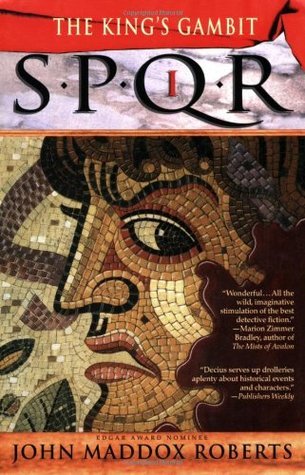
The King’s Gambit by John Maddox Roberts – Book Review

The King's Gambit by John Maddox Roberts – Book cover

In the opening volume of what is now a historical crime series spanning more than ten books, Decius, a low-ranking official at the very bottom of the Roman hierarchy, begins investigating the murder of a freed slave. The time: 70 BC, smack in the middle of the Roman Republic’s period of crisis. And guess who Decius runs into right in the very first chapter of The King’s Gambit? Bingo, you got it: the equally green and freshly ambitious Gaius Julius Caesar. Later on, of course, more famous faces from the era show up—everyone from Pompey the Great and Cicero to the scoundrel Publius Clodius Pulcher.

More of a Historical Novel than a Whodunit

Now, technically speaking, The King’s Gambit is a crime novel—it checks off a bunch of the genre’s usual boxes (forensic expert, informant, tough-guy sidekick)—but you still kind of feel like you’re reading historical fiction. The investigation itself is pretty thin, not particularly thrilling or original (there are moments when John Maddox Roberts rather clumsily uses well-known historical facts just to nudge the plot forward—hello, pirates), and most of the time it gets drowned out by long digressions into the political and historical dynamics of the day. Not least because young Decius becomes OBSESSED with the idea that he’s stumbled right into the middle of an anti-state conspiracy. And that everyone is out to get him. Um… what?!

A Conspiracy? Oh, Please.

That grand conspiracy claim eventually fizzles out and turns into nothing more than a plain old political scheme. Typical. But Decius doesn’t let go—he keeps digging into the case. No one understands why he’s MAKING SUCH A FUSS over a murdered slave. No one. Not even you.

The first book in John Maddox Roberts’s SPQR series honestly feels more like the pilot episode of a detective TV show. It’s a bit clunky, a little unsteady, but maybe not terrible—and you can’t help but hope the series eventually finds its stride.

It Feels Like You’re Actually in Rome

What definitely works in The King’s Gambit’s favor, though, is its setting, which feels completely authentic. For instance, I gave up on the similarly themed Gordianus series precisely because it lacked that feeling. It didn’t help that I had just finished reading Colleen McCullough’s epic Masters of Rome series, which made Gordianus fall flat by comparison.

Luckily, The King’s Gambit doesn’t suffer the same fate. In fact, quite the opposite. Almost every other paragraph drops in some piece of information so naturally woven into the text that it helps you better understand the political and civic backdrop of the time—or just makes you feel like you’re right there, tagging along with eager-beaver Decius through the cramped, stone-paved alleyways of ancient Rome.

Rating: 6.9/10

The King’s Gambit (SPQR #1) by John Maddox Roberts
274 pages, Paperback
Published in 1990 by Minotaur Books

You might also like:
The Fort by Adrian Goldsworthy

Gods of War by James Lovegrove – Book Review

Gods of War by James Lovegrove - Book cover

A Lukewarm Investigation Begins

In Gods of War, James Lovegrove’s crime novel, Sherlock Holmes is now in his sixties. No surprise, then, that his joints creak and crack like an old staircase. And chubby Dr. Watson? Let’s be honest—he’s not exactly in top shape anymore either. Lucky for them, they barely need to do anything in this story.

The great detective, get this, can’t even be bothered to pull off the biggest cliché in every Holmes story—using his signature method to deduce, without breaking a sweat, what extraordinary adventures his long-lost buddy had on his train ride—because, supposedly, he’s “too excited about the new case.” Which, by the way, turns out to be nothing more than a pathetic little burglary.

(Feels a bit cheap, doesn’t it? I mean, how hard would it have been for Lovegrove to throw in that Watson’s seatmate across the aisle was an elderly, half-limping horse trader from Devonshire on his way to buy feed for his prize stallion, Oxhead—while to his right sat a spinster in a pheasant-feathered hat, off to visit her sister, who suffers from trichotillomania, casually reading Northanger Abbey, fourth edition.

Cost him nothing.)

Laurel and Hardy Back on the Case!

Read more

The Helicopter Heist by Jonas Bonnier – Book Review

The Helicopter Heist by Jonas Bonnier - book cover

A Scandinavian Crime Novel, With a Touch of Robbery

Jonas Bonnier’s book is roughly the chance meeting on the dissecting table of Scandinavian crime and documentary fiction. Or something like that. Not entirely, though, because the genre is mostly referenced through the setting, but the usual whining is nowhere to be found. (You know, when the noble Nordic characters are relentlessly depressed from page one, yet their names and genders remain a mystery for ages.) And if you’re worried – since the book is based on a true story – that it’s just a list of facts thrown together, you can forget that, too. The Helicopter Heist has been streamlined into a full-on novel.

In 2009, a few guys robbed the G4S cash logistics company’s Stockholm depot using a helicopter. (Hundreds of millions of kronor were flying around.) The novel tells the story of the planning and the heist.

Bad Guys? Interesting!

Bonnier’s book isn’t as thrilling or full of twists as the heist genre would lead you to expect. The part of the book dedicated to preparation, unsurprisingly, takes up most of the story and could be described as, at best, moderately interesting. (Obviously, things pick up during the action part.)

Read more

Chasing the Dead by Tim Weaver – Book Review

Chasing the Dead by Tim Weaver - Book Cover

You might already be drooling in anticipation because Chasing the Dead by Tim Weaver seems like one of those dark and brooding crime thrillers that Dennis Lehane typically delivers. And to be fair, the book does start off on the right foot: you immediately empathize with David Raker after his great tragedy, and maybe you even grow to like this meek, good-hearted soul. The investigation is solid enough too, barring a few hiccups in the dialogue, like:

“Yes?”
“Yes.”
“Really?”
“Really.”
“Are you sure it’s really real?”

Why is everyone acting so weird here?!

Furthermore, Tim Weaver introduces such a twisted antagonist that you might just crap your pants! You’re so freaked out that you barely notice how bizarre most of the characters in Chasing the Dead are. For instance, they casually rat out their well-paying clients for a measly 200 quid or, for no apparent reason, suddenly off themselves!

Read more