Thin Air by Richard Morgan – Book Review

Thin Air by Richard Morgan – Book Cover

Genetically Modified Noir on Mars

In 2008, Richard Morgan wrote a book about a genetically modified Martian super-soldier who wins a lottery ticket back to Earth and comes home to do some sleuthing. Ten years later, he wrote another one titled Thin Air, where the protagonist is again a genetically modified super-soldier, but this time he’s investigating the disappearance of the Martian lottery winner – on Mars, several hundred years later.

I’d bet on it, that Morgan captures many of us with his macho protagonist because it’s truly heartwarming to see such a competent, skilled individual at the center of the action, someone who occasionally rips apart those who get in his way during his investigations. But the focus isn’t on the ripping apart, of course – despite a strong emphasis on action, Thin Air is ultimately a crime novel, specifically in the noir sub-genre.

Washed-up protagonist? Check.
Femme fatale? Check.
Nefarious conspiracy in the background? Check.

Read more

One Shot by Lee Child – Book Review

One Shot by Lee Child – Book Cover

My role model (see Die Trying), Major Jack Reacher, makes his first appearance in One Shot on page 42. How is that possible? I have no idea. Moreover, I thought I had already read this book before. But no, I missed this volume, and that’s great news because in this early installment, the Major is at his best. And of course, so is Lee Child. And naturally, this is the book that was adapted into the cool movie Jack Reacher (IMDb: Jack Reacher) where Tom Cruise does everything to RISE to the role.)

Child’s book is thrilling from the first page.

How can you tell? Well, despite our beloved hero’s late appearance, you find Lee Child’s story unputdownably exciting from the very first page.

Then Reacher barges in and once again sticks his nose into something he shouldn’t. And once again, he’s nosy, impertinent, and unshakeable… And once again, it turns out that things that seem entirely obvious aren’t so obvious after all.

How does Jack Reacher do it? Using the good old Sherlock Holmes method. Things that would mean nothing to you, spark something different in his mind. Things you would immediately declare as black, he flips around and proves to be white.

Read more

Die Trying by Lee Child – Book Review

Die Trying by Lee Child - Book cover

Since hardly anyone reads this blog anyway, I think I can safely admit—without becoming a public laughingstock—that Major Jack Reacher is one of my all-time role models! Yep, I said it. Big words, I know. But anyone who reads the thriller Die Trying will definitely find themselves admiring Lee Child’s ex-military cop hero from that point on.

Jack Reacher. Role Model. Period.

My role model, Major Jack Reacher, in the second installment of Lee Child’s excellent series (which I picked up again after some 20 years and accidentally reread) finds himself in the back of a van—alongside a very attractive FBI agent. She’s been kidnapped. My role model, Major Jack Reacher, just so happens to be in the wrong place at the wrong time and ends up in the van by accident. The hopelessly dumb kidnappers in Die Trying don’t just toss him out of the van—they drag him with them. These poor fools have no idea what kind of trouble they’ve just signed up for.

Because my role model, Major Jack Reacher, is strong, smart, highly trained, cunning, and more Sherlock than Sherlock Holmes himself (see: The Hound of the Baskervilles). (Just watch how he analyzes the girl at the beginning.) His sense of justice is off the charts. He’s also the best sniper around. (You can bet a few people are gonna take a bullet to the head.)

Read more

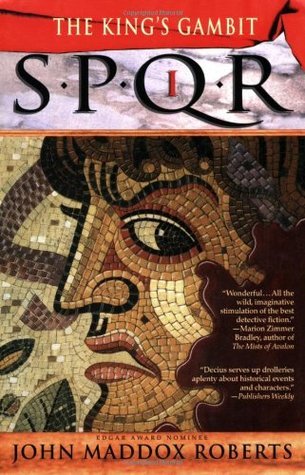
The King’s Gambit by John Maddox Roberts – Book Review

The King's Gambit by John Maddox Roberts – Book cover

In the opening volume of what is now a historical crime series spanning more than ten books, Decius, a low-ranking official at the very bottom of the Roman hierarchy, begins investigating the murder of a freed slave. The time: 70 BC, smack in the middle of the Roman Republic’s period of crisis. And guess who Decius runs into right in the very first chapter of The King’s Gambit? Bingo, you got it: the equally green and freshly ambitious Gaius Julius Caesar. Later on, of course, more famous faces from the era show up—everyone from Pompey the Great and Cicero to the scoundrel Publius Clodius Pulcher.

More of a Historical Novel than a Whodunit

Now, technically speaking, The King’s Gambit is a crime novel—it checks off a bunch of the genre’s usual boxes (forensic expert, informant, tough-guy sidekick)—but you still kind of feel like you’re reading historical fiction. The investigation itself is pretty thin, not particularly thrilling or original (there are moments when John Maddox Roberts rather clumsily uses well-known historical facts just to nudge the plot forward—hello, pirates), and most of the time it gets drowned out by long digressions into the political and historical dynamics of the day. Not least because young Decius becomes OBSESSED with the idea that he’s stumbled right into the middle of an anti-state conspiracy. And that everyone is out to get him. Um… what?!

A Conspiracy? Oh, Please.

That grand conspiracy claim eventually fizzles out and turns into nothing more than a plain old political scheme. Typical. But Decius doesn’t let go—he keeps digging into the case. No one understands why he’s MAKING SUCH A FUSS over a murdered slave. No one. Not even you.

The first book in John Maddox Roberts’s SPQR series honestly feels more like the pilot episode of a detective TV show. It’s a bit clunky, a little unsteady, but maybe not terrible—and you can’t help but hope the series eventually finds its stride.

It Feels Like You’re Actually in Rome

What definitely works in The King’s Gambit’s favor, though, is its setting, which feels completely authentic. For instance, I gave up on the similarly themed Gordianus series precisely because it lacked that feeling. It didn’t help that I had just finished reading Colleen McCullough’s epic Masters of Rome series, which made Gordianus fall flat by comparison.

Luckily, The King’s Gambit doesn’t suffer the same fate. In fact, quite the opposite. Almost every other paragraph drops in some piece of information so naturally woven into the text that it helps you better understand the political and civic backdrop of the time—or just makes you feel like you’re right there, tagging along with eager-beaver Decius through the cramped, stone-paved alleyways of ancient Rome.

Rating: 6.9/10

The King’s Gambit (SPQR #1) by John Maddox Roberts
274 pages, Paperback
Published in 1990 by Minotaur Books

You might also like:
The Fort by Adrian Goldsworthy

Gods of War by James Lovegrove – Book Review

Gods of War by James Lovegrove - Book cover

A Lukewarm Investigation Begins

In Gods of War, James Lovegrove’s crime novel, Sherlock Holmes is now in his sixties. No surprise, then, that his joints creak and crack like an old staircase. And chubby Dr. Watson? Let’s be honest—he’s not exactly in top shape anymore either. Lucky for them, they barely need to do anything in this story.

The great detective, get this, can’t even be bothered to pull off the biggest cliché in every Holmes story—using his signature method to deduce, without breaking a sweat, what extraordinary adventures his long-lost buddy had on his train ride—because, supposedly, he’s “too excited about the new case.” Which, by the way, turns out to be nothing more than a pathetic little burglary.

(Feels a bit cheap, doesn’t it? I mean, how hard would it have been for Lovegrove to throw in that Watson’s seatmate across the aisle was an elderly, half-limping horse trader from Devonshire on his way to buy feed for his prize stallion, Oxhead—while to his right sat a spinster in a pheasant-feathered hat, off to visit her sister, who suffers from trichotillomania, casually reading Northanger Abbey, fourth edition.

Cost him nothing.)

Laurel and Hardy Back on the Case!

Read more

Chasing the Dead by Tim Weaver – Book Review

Chasing the Dead by Tim Weaver - Book Cover

You might already be drooling in anticipation because Chasing the Dead by Tim Weaver seems like one of those dark and brooding crime thrillers that Dennis Lehane typically delivers. And to be fair, the book does start off on the right foot: you immediately empathize with David Raker after his great tragedy, and maybe you even grow to like this meek, good-hearted soul. The investigation is solid enough too, barring a few hiccups in the dialogue, like:

“Yes?”
“Yes.”
“Really?”
“Really.”
“Are you sure it’s really real?”

Why is everyone acting so weird here?!

Furthermore, Tim Weaver introduces such a twisted antagonist that you might just crap your pants! You’re so freaked out that you barely notice how bizarre most of the characters in Chasing the Dead are. For instance, they casually rat out their well-paying clients for a measly 200 quid or, for no apparent reason, suddenly off themselves!

Read more