Past Tense by Lee Child – Book Review

Past Tense by Lee Child – Book Cover

The “Past Tense” is the 23rd Reacher novel. When I stumbled upon Lee Child about 20 years ago, it was almost like a revelation. Well, maybe not that, but damn, it was good. After that, no matter how hard I tried with any other similar bestselling author, you can imagine the result. None of them came close. Not even in the ballpark. It was all mediocre crap from Linwood Barclay to Michael Robotham.

Twenty-three parts of roughly similar quality in a book series is really something. Hungarian national pride, the Leslie L. Lawrence series, became a parody of itself around the sixth installment. The first worrying signs for Lee Child started to emerge around the 20th installment. Of course, the series was always heavily coated with a kind of over-the-top feeling, which maybe isn’t bad until there’s a serious story behind it. This is missing now, for the first time, in the book titled “Past Tense.” Reacher’s attempt to turn a sleepy family tree research into a investigation turns out to be so thin that the author is forced to insert a parallel subplot with new perspective characters. The young female member of the couple is just as masterful an analyst as the major himself. However, while you can believe Reacher in this, the girl is just not convincing.

The lack of a solid crime foundation makes the familiar motifs mostly seem tiresomely contrived. The meticulous description of things that are usually mundane in investigative work can sometimes be mind-numbing. For example, the author elaborates on the structure and use of a computer mouse. Thank you very much, major, we’ve been using it daily for almost forty years! You also incredulously observe Reacher having to find out such trivial matters as where random supporting characters are going to sneak off for a little hanky-panky.

Jack Reacher, the perpetually sniffing unbeatable dispenser of justice, becomes an ordinary mortal as he handles official matters: and shows a great deal of insensitivity, such as gleefully using up poor Reverend Burke’s entire phone credit; or looking completely idiotic while demonstrating his special skill, – yes, just like Mr. Vekker – constant mental timekeeping.

To make matters worse, he routinely beats up a few disagreeable douches just like Tarzan (see Tarzan and the Leopard Men). Because, much to your regret, it slowly becomes apparent that Reacher, in fact, is a violent character who constantly abuses his physical superiority, sticking his nose into other people’s business whether they like it or not.

If you devoured the pages of the previous books, well, you won’t with “Past Tense”. This is the weakest part of the Jack Reacher series so far, and a warning sign for the sad future ahead. 🙁

6.9/10

Past Tense (Jack Reacher #23) by Lee Child
382 pages, Hardcover
Published in 2018 by Delacorte Press

Other work(s) of the author:
Die Trying by Lee Child

Dawn by Octavia E. Butler – Book Review

Dawn by Octavia E. Butler - Book Cover

The Earth’s got a tough deal. Octavia E. Butler’s “Dawn” serves up a background story where it’s not global warming or some similar modern catastrophe that puts us on the skids, as we’re just starting to experience firsthand, but rather the good ol’ Americans and Soviets doing the orthodox thing, nuking each other. Small detail. Here come the aliens, scooping up quite a few survivors. After a few centuries, they pull them out of cryo, and give them a choice: you can start afresh on the planet and mess it up again, assuming you agree to bear common offspring with us.

Big question: would you be down for a little hanky-panky with a tentacled alien if it meant the survival of your species? Hell yeah? Bucket on their heads and let’s go?

Of course, it’s not that simple. According to Butler’s “Dawn’s” somewhat sluggish story, the aliens’ obsession is the shared offspring. Just because. There isn’t really a sensible explanation for it, just the occasional clumsy excuse or exaggerated enthusiasm for our restless species’ gene pool.

From the closed spaces of the alien’s plant-based spaceship (haha! – in Saga, this might actually work), you initially associate more with chamber drama than sci-fi, and when the awakened characters multiply, you might think of a cross between The Real World and Naked and Afraid. There’s a bit too much soul-searching going on. And to top it off, the space manipulators, alongside their calm indifference, mostly try to achieve their goals through emotional blackmail.

And humans… humans are, well, humans. They are jerks. Impatient, clueless, and as usual, bickering; and whoever feels stronger than others also throws a few punches. But eventually – presumably against Octavia E. Butler’s intentions – you realize you can’t fully condemn them either, because in their sly, passive-aggressive way, the aliens are just as big jerks. And dirty MOLESTERS too.

Hard sci-fi? Yeah, my ass! “Dawn” is more like a promising basic idea clumsily unfolded, resembling at times a better-executed amateur novel.

6.5/10

Dawn (Xenogenesis #1) by Octavia E. Butler
248 pages, Paperback
Published in 1997 by Warner Books

UPDATE: Warning! The sequel goes even more off the rails. Just read the damn blurb, and you’ll rate it below 5/10 sight unseen…

Boy’s Life by Robert McCammon – Book Review

Boy's Life by Robert McCammon - Book Cover

Well, it’s already clear from the introduction that you’re dealing with a verbose novel. But if that doesn’t scare you off too much, then everything’s okay, because the rest of “Boy’s Life” is not THAT dire. (Except for the very end: those three closing words are no small feat.)

Each chapter of the book is like a little novella. Some are better done (wasps), some less so (the UFOs), and by page 100, the story is still just at the exposition. And you’re waiting, thinking, “Okay, so what’s going to come out of this?” Then suddenly you realize that nothing special will. Then you also realize that it’s not such a huge problem; “Boy’s Life” doesn’t want to be anything more than just a boy’s and a town’s life through the former’s perspective, roughly over a year in the American South in 1964. But it’s certain that you’d be a wreck if all this happened to you in just one miserable year.

The chapters move the plot forward particularly slowly, and although some feel completely unnecessary and overwritten (Welcome, Lucifer or Get around), sometimes an event only makes sense much later – or has an impact on the characters. In short, there are also some that, besides being unnecessary and verbose, are also quite clumsy (Green-Feathered Hat).

Occasionally, the text indulges in commonplace preaching (both dream sequences).

However, the character portrayal in “Boy’s Life” is, hey, very well done; whoever emerges in the story is completely unique and memorable, and some characters are downright MAGNIFICENT, see for example, The Demon, the teenage monster, or The Lady, Vernon, or even the cosmic-paced Mr. Lightfoot, and you JUST CAN’T PUT THE BOOK DOWN because you can’t wait to meet them again. It’s rare to read a book where even the most minor character is so clearly identifiable. Also, the seemingly exceptional insight into human nature, from which the former presumably arises, is a rarity – thus, suddenly Tolstoy’s “War and Peace” or G. R. R. Martin’s “Game of Thrones” series come to mind, where the same can be observed (although in the case of the latter, the situation is made more difficult by the hundreds of bustling characters).

Robert McCammon’s book is mainly a young adult adventure novel, but not at all childish, because it speaks in the voice of a retrospective adult, with occasional glimpses of good-natured irony and mature wisdom between the lines. The text is pervaded by mystery, the typical Southern themes like racism, the supernatural world, and voodoo. But it also contains motifs of westerns and psychological drama – and of course, the crime genre, which frames the whole story, although this part is the thinnest, the most boring, and the least successful… when the parrot speaks, you immediately figure out where it’s all going.

In the infinitely sentimental (watch out, don’t cry!) and, needless to say, overly long epilogue, McCammon even sends some of the characters off in such a way that they immediately step out of their own characters (Gordo, Chile, and the poor Demon too).

And if this book has so many flaws, then why did it become such a freaking huge success?

Perhaps because “Boy’s Life” turns nostalgically to a time when family was even more defining, when the universal validity of love for each other was more pronounced. When kids were still kids and played outside, instead of sitting indoors in front of various screens, while everything slowly turning plastic around them. In the first place their stupid brains!

7.6/10

Boy’s Life by Robert McCammon
610 pages, Paperback
Published in 2008 by Gallery Books

Legends of the Fall – Film Review

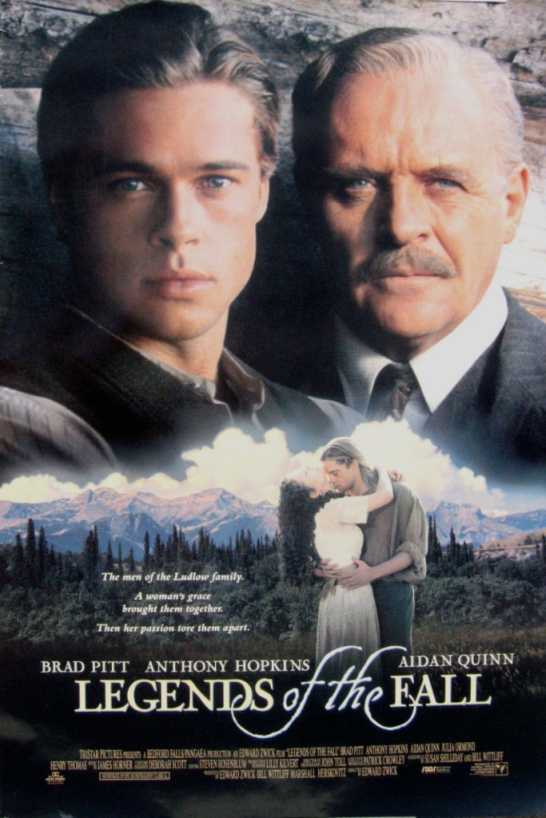
Legends of the Fall - Film Poster

Colonel Ludlow, weary of the Indian massacres, settles down in the remote Montana long-long ago, three sons are born, and so on. And when the youngest brings his bride, the STUNNING Suzannah, even the other two boys start to drool over her. As if that wasn’t enough, World War I breaks out just then.

And what’s the point? It’s not good to throw around big words, but there’s nothing to be done when this is the situation. Now listen: the film drama “Legends of the Fall” teaches you that no matter how diligently you obey all laws of God and man, you can still end up with EVERYONE loving someone else who outrightly flouts these laws. Can you do anything about it? Nothing, you just got screwed. Thanks a lot!

At most, you can toughen up your soul, because this film is shamelessly and unabashedly manipulative, every effort aimed at bringing tears to your eyes.

Little “M” for example, kept watering the mice, so eventually I had to keep a list, and in the end, it turned out that Edward Zwick’s esteemed masterpiece brought tears to the little one’s eyes precisely a dozen times during viewing. Quite an achievement!

This goddamn film affects the viewer like this, even if you know exactly that most of the characters’ troubles – alongside the damn scriptwriters – are caused by stubbornness bordering on stupidity or incomprehensible self-will, and they wouldn’t get into such a mess if they showed a little more empathy or at least some PATIENCE towards each other.

So if you feel as tough as nails, but just to be on the safe side, you want to check, watch “Legends of the Fall.” And if your eyes don’t well up once during it, well then you really are!

8/10

Legends of the Fall (1994) (IMDb)
Director: Edward Zwick, Stars: Brad Pitt, Anthony Hopkins, Aidan Quinn, Julia Ormond

V for Vendetta by Alan Moore – Comic Book Review

V for Vendetta by Alan Moore - Comic Book Cover

The England of the 1980s wasn’t exactly a cheerful place (hello, Mrs. Thatcher). But Alan Moore anticipated that it will be even less cheerful in the future — although in hindsight, the nightmare vision of complete fascism seems a bit exaggerated. Anyway, the main message of “V for Vendetta,” which essentially says, “Fascism is bad, mmkay?” remains relevant forever. However, the other essential part of the message, which claims, “Anarchy is good, mmkay?” not so much.

V, the vengeance-seeking vigilante with a Guy Fawkes mask, sets out to dismantle the system like a crazy kid smashing a snowball, increasing your satisfaction with the repugnant demise of the dictatorship’s revolting figures in the opening chapters. For a while. Then you start to worry that okay, okay, but this is a bit one-dimensional, when the detective subplot intensifies and the mystery factor briefly elevates the whole thing, and you REALLY start to wonder who this immensely theatrical character behind the mask really is:

A mad genius, a master strategist, a bulletproof martial artist, and the luckiest guy alive, who’s good at EVERYTHING? Untouchable by anyone? Yes. And that’s precisely what diminishes the enjoyment of “V for Vendetta.” The many evil bastards are no match for V. The outcome of the game cannot be in doubt.

In the final third of the comic, as V’s master plan reaches its climax, and you observe the machinations of the insignificant, petty side characters, you might start to grow weary of the whole shebang. Especially when you realize that they’re all chess pieces on V’s board. Sometimes, unfortunately, you can’t even distinguish one from another due to the blurred, faded drawings. These drawings, however, provide an excellent BACKGROUND for the dark, gray, oppressive England, where radioactive ash falls from the sky, and Nazi propaganda blares from the speakers.

Regarding Detective Finch’s case, the grand plan stretches the bounds of credibility, as it’s highly unlikely for a drugged, deranged individual to stumble exactly where you cleverly calculated. Likewise, it’s highly debatable whether the most suitable person for the task is the one you’ve prepared for it.

According to Alan Moore’s philosophy, there are two types of anarchy: destructive, which breaks down the undeserving system, and constructive, which ideally follows afterward — during which people take control of their destiny. Now that’s something you really wouldn’t want to bet heavily on. It is highly likely, however, that these upstanding citizens, in the midst of constructive anarchy, would trample over each other’s heels to rally under the banner of the first nauseating figure promising them a “brighter future”.

6.5/10

V for Vendetta by Alan Moore & David Lloyd (Illustrator)
296 pages, Hardcover
Published in 2005 by Vertigo

Three Apples Fell from the Sky by Narine Abgaryan – Book Review

Three Apples Fell from the Sky by Narine Abgaryan – Book Cover

If they compare Narine Abgarjan’s book to “One Hundred Years of Solitude” on the cover, you’re forced to do the same, measuring it here and there; for example, the part of the text about the rooster isn’t quite right, but when the mold consumes everything, it’s entirely as if García Márquez himself wrote it. Then around page 40-50, you realize it’s entirely pointless to compare anything; “Three Apples Fell from the Sky” stands on its own, thank you very much. Granted, it doesn’t condense the history of half a continent into 100 years, but rather narrates about 90 years of an Armenian mountain village, but it does so in such a beautiful, uniformly undulating style that you’d be tempted to move there—unless you fear being permanently cut off from the internet and having to work your butt off for your daily bread.

Anatolia and Vasily, the two lonely widowers, are being pushed towards each other by their acquaintances. And while you wait for Vasily to finally make a move—because his chosen one, who expects nothing more from life, is just lying down to die—the story weaves around these characters, jumping back and forth in time, painting the lives of two or three generations of ancestors, relatives, friends, and neighbors. Us Hungarians, there’s no doubt we’ve had our fair share of trouble in our history. Well, Armenians have had about five times as much. Still, the national tragedy, the “great massacre” is only hinted at in two throwaway sentences; the emphasis is far from the trials and tribulations.

“Three Apples Fell from the Sky” is a paean to the ancestors, to the village, to the peasant way of life in the positive sense, which has largely disappeared there as well, just like here. The style, while not magical realism, comes close to it; it’s fairy-tale-like, but not really a fairy tale. What might throw it off its course a bit is when the narrative parts are outweighed by dialogues, like Vasily’s urban adventures towards the end of the story; those are a bit off: Vasily couldn’t really be this simple-minded. But you easily believe that more or less everything could have happened like this. (The supernatural elements surrounding two other characters seamlessly fit into the story.)

Meanwhile, the best supporting character is a dog: Patro.

You can jot down the food too, to check them on some recipe website. (I got curious about Armenian yogurt soup.)

And you can marvel at how in a community, the “May the neighbor’s cow die too!” principle isn’t the most characteristic, as it is with us, but rather, if someone needs help, they’ll lend a hand. (And you say this even though a clueless douchebag and his annoying, nosy, cauliflower-eared, bitchy wife are your neighbors, may the good Lord kick them in the rear!!)

There’s a lesson too: it’s never too late to find happiness. Even if it sounds cheesy. And this lesson is also wrapped in quite a bitter pill; sentimentality isn’t really typical of this novel. Not like with the short stories following the novel, which, well, let’s say they feel like typical soppy, women’s writing. But you read through them to speculate about who corresponds to whom in the novel, and in the process, you find yourself feeling quite sad.

8/10

Three Apples Fell from the Sky by Narine Abgaryan
256 pages, Paperback
Published in 2020 by Oneworld Publications

The Whispering Room by Dean Koontz – Book Review

The Whispering Room by Dean Koontz - Book cover

I had never read anything by Dean Koontz before, although I’ve started several of his books. Then I stopped each one after a few pages. No big deal. They were just too uninteresting. Then came the first installment of the Jane Hawk series, and I couldn’t put it down. Well, it’s as if Dean Koontz suddenly found his stride. If you’ve read it too, well, you’ve found yourself a great conspiracy thriller. And you’ve discovered that Jane is the counterpart to your role model, Jack Reacher (see Lee Child: Die Trying) – equally effective, less brutal, and much sexier. She’s just ruthless enough to keep the story believable.

A few scumbags got what they deserved in the first part, in “The Whispering Room”, and the rest will follow in the series. The plot runs on multiple threads, perhaps to avoid repetition, because let’s face it, Jane’s investigation is pretty much the same as reading the first part all over again. Which is actually not a problem. The other thread is fine too. Then the two storylines intersect at one point, and things slow down a bit, especially with the “December update” – you might raise an eyebrow at this, which seems a bit exaggerated even for a conspiracy thriller. The Dark Zone wasn’t exactly a pillar of credibility either, but it worked within its own framework. So, if you were plotting a conspiracy against USA, you’d be better off not complicating things too much and definitely not wasting valuable nano-thingamajigs on a bunch of useless average people. And you’d probably fail miserably in Jane’s rescue mission too, which is completely pointless and instantly impractical from the main mission’s perspective. Well, for you it would be. Not so much for Jane.

Fortunately, “The Whispering Room” finds its way back in the end. The final chapters are quite exciting, and before that, Bernie Riggowitz’s appearance adds some humor and compassionate goodwill to Jane’s seemingly hopeless crusade – although it’s another question whether Bernie’s amateur acting is the clumsiest scene in the book. Whatever, Bernie’s inclusion still ends up on the positive side overall.

Another thing you might notice is that Koontz’s book tries to be much more literary compared to the first part. Emphasis on the word TRIES. He mainly achieves this by placing AT LEAST two lengthy and convoluted analogies on every page, which eventually makes your eyes start to glaze over at the sight of “as if” and “like” every now and then. What’s the point anyway? Casting pearls before swine? The Jane Hawk series is still just an average thriller. Okay, a little better than that.

7.5/10

The Whispering Room (Jane Hawk #2) by Dean Koontz
528 pages, Paperback
Published in 2018 by HarperCollins Publishers Ltd

Attack on Titan – Series Review

You have no idea what anime is? Neither did I, really. (It’s a cartoon, basically.) But Little EM nagged me for a whole year—well, if you can call open and shameless blackmail nagging—until I had to give in. “Attack on Titan is the best anime! Everyone’s watching Attack on Titan!” claimed Little EM. Maybe so, although the real question is how long they’re watching. If you want what’s best for yourself…

How does the series start anyway? It starts off damn well. Humanity has been living behind enormous walls for a hundred years. Outside the walls, there are naked, androgynous, and horribly stupid giants who hunger for human flesh. It’s like zombies, only bigger than apartment buildings. In the first episode, the giants break through the wall. After watching it, you’ll probably just gawk and say, “I’ve never seen a stronger series opener, not even Lost or The Shield, compare to this.”

Attack on Titan - TV Series - Season 1

Unfortunately, it’s all downhill from there. It feels like the creators locked a bunch of twelve-year-olds in a room, had them compete to come up with the dumbest idea, and the winner’s idea got passed along. There’s no sense to the story; it’s like they’re always trying to make something big happen, and as quickly as possible. The first two seasons could have easily explored how humanity recovers from the initial shock, how they slowly gear up for an unequal fight against the almost unbeatable enemy. Instead, they throw in two twists, right at the beginning (the first being the protagonist’s, uh, transformation, and the other involving the giant girl), which completely undermine the otherwise strong premise. And don’t even get me started on the Abnormals, special giants with unique abilities. Armor, teleportation, who knows what else. All these elements successfully reduce the series to a stupid fairy tale.

And believe it or not, that’s the lesser issue. The bigger problem is that the creators of Attack on Titan are incapable of writing sensible dialogue. All the conversations are garbled, pompous repetitions. Plus, most of the characters, whether necessary or not, SCREAM AT THE TOP OF THEIR LUNGS. Especially Eren, the protagonist, who can ONLY COMMUNICATE BY SCREAMING. So, if his little buddies in the Scout Regiment disagree with him, they don’t politely ask,

“Hey, what the frakkin’ hell are you doin’, chimmy-chummy?”

Instead, they SHOUT in his face, “You’re preparing for the downfall of humanity with your actions. Admit that you’re an enemy of humanity!” And so on. This compulsive grandiloquence renders every conversation completely unbelievable and ridiculous.

But the childishness and thoughtlessness extend to every other aspect of the series as well. Whenever the characters find themselves in a crisis (which happens quite a few times), with about 10 seconds to avert the crisis, you can bet 500 yen against the armored giant’s left testicle that they’ll spend AT LEAST 10 minutes lamenting, philosophizing, or struggling with themselves over what to do—while you angrily pound the armrest of your chair in front of the TV and start SHOUTING yourself: “Your time’s up, you miserable idiots!”

At least one recruit participating in military training has a HYSTERICAL BREAKDOWN due to the bleak future ahead, and a third of the episode is spent with the others comforting them. Meanwhile, in sharp contrast, and only incidentally, it turns out that due to overcrowding behind the walls, 250,000(!) civilians were driven out to fight against the giants—to reduce the population inside. The brilliant plan was a success. The giants ate them all. Problem solved. It couldn’t have been easy to convince these 250,000 civilians to join the action; they were probably all forcibly pushed out the gate and weapons were thrown after them at the end, to prevent any recklessness inside. Or if not, they all were probably EASILY INFLUENCED retirees.

Read more

Saga: Volume Two by Brian K. Vaughan · Fiona Staples – Comic Book Review

Saga: Volume Two by Brian K. Vaughan · Fiona Staples - Comic Book cover

Well, if you thought Brian K. Vaughan slowed down the pace for the second installment of Saga, then you’re mistaken. The two enamoured deserters from Landfall and Wreath’s galaxy wide war continue their rampage – now accompanied by the mama-in-law and papa-in-law of the new mother. The introduction isn’t exactly smooth sailing, but who can resist melting at the sight of a brand new grandchild – especially when they see the horn buds on the little one’s noggin.

The mother-in-law blasted baby Hazel’s new, ghost-babysitter (with her dangling out intestines) out of the game at the end of the previous installment – and you couldn’t help but lament what a loss it was. She was such a cool character. Well, what can we say, she’s not the only one flying into the void.

Of course, there are new characters to fill the gaps left behind, (though it’s obvious that The Stalk can NEVER be replaced). For instance, seeing Marko’s ex-fiancee, you seriously ponder how this dull ass swapped out that gorgeous, fiery chocolate baby for this not-so-morally-solid current wife. (Well, probably because he’s a dull ass.) Gwendolyn would have GUARANTEED you’d never be bored for a second with her. Although, hm, it’ll probably work out with Alana too, at least until she gets bored of him…

You won’t miss shocking twists either, in fact, it feels like they may have overdone it with the story’s twisting this time around, a slightly slower pace might have suited the story better. Although you might think so just because you can reach the end of this slender volume in moments, which is a few pages shorter than its predecessor.

However, Prince Robot IV. is – now confirmed! – a genuine douchebag. Well, so that no human feeling gets caught in his circuits! Hopefully, someone will smash his screen in the next installment!

What you noticeably encounter less of compared to the first volume is the in-your-face primary sexual characteristics. (That’s right, maybe in the next volume.) Until then – even if quantity doesn’t make up for quality – presumably, Fard’s not-too-trustworthy testicles will hover in your mind’s eye.

8/10

Saga: Volume Two by Brian K. Vaughan & Fiona Staples
144 pages, Paperback
Published in 2013 by Image Comics

(Saga: Volume Two collects: Saga #7-12.)

Review of the previous volume:
Saga: Volume One

Ross Poldark by Winston Graham – Book Review

Ross Poldark by Winston Graham - Book cover

Ross Poldark, a captain with a gunshot ankle, limps home to picturesque Cornwall from the American Revolutionary War. His father is dead, the house is in ruins, and his fiancée has replaced him with his cousin. As Ross sets out to restore his dilapidated home, his self-esteem, and embark on farming, you get a glimpse into the daily life of late 18th-century South England. It wasn’t the most uplifting place at the time: the war has plunged the country into recession, the mining industry, the cornerstone of Cornwall’s economy, is struggling, the upper classes revel while the lower ones suffer. Ross’s useless employees, inherited from his father, drink like fish, and Ross himself isn’t averse to a tipple. You have no idea how this will turn out.

Then Demelza arrives.

Demelza is a 13-year-old, impoverished half-orphan whom Ross rescues from her brutal father and takes in as a housemaid. He couldn’t have done anything better. From this point on, you can’t wait to read about Demelza; her pages, especially with their poignant nature, overshadow the rest of the novel. Demelza is getting older, becoming more astute, and then sets out to capture Ross’s attention…

Many liken the first volume of the Poldark series to “Pride and Prejudice.” I wouldn’t know, as I haven’t read it; I only started with the 1995 Colin Firth series adaptation, but after about 10 minutes, I tossed the remote due to its superficial and exaggerated nonsense. Winston Graham’s book is emotional but not sentimental. It’s much more of a family saga with social sensitivity than a romantic novel, and it doesn’t feature the silly twists typical of women’s genre fiction.

A romantic novel would end with the main characters getting married. Their story really only begins after Ross impulsively marries the girl: you, on the other hand, watch contentedly as Demelza rises to Ross’s intellectual and then social level, and by the end, they become equal partners in the relationship.

Interestingly, it’s as if Demelza not only has a positive influence on Ross and you but also on the novelist: with the marriage, the quality of the writing improves, the style becomes more cohesive, and elaborate nature descriptions start adorning the text, while the uninteresting subplots (Jim and Jinny & other miners – who occasionally had their own perspectives) either seamlessly integrate into the narrative or disappear altogether. And you notice that you CAN’T PUT DOWN this volume.

8/10 (80%)

Ross Poldark (The Poldark Saga #1) by Winston Graham
379 pages, Paperback
Published in 2015 by Sourcebooks Landmark